
Holy Week in Badajoz is presented as a fascinating combination of spirituality, history, art, color, and austerity, standing out with recognition as a “Festival of National Tourist Interest” in 2011.
The deep-rooted tradition of the Semana Mayor of Badajoz dates back to the XVI century, with more than forty brotherhoods that have paraded through its streets over the years. Today, eleven of these brotherhoods, each with its own narrative, display monuments and works of art in the most picturesque corners of the old town. This commendable effort is carried out thanks to the discreet work of the “costaleros,” who assume the crucial responsibility of carrying the steps.
The beginning of the festival takes place on Friday of Sorrows and culminates on Easter Sunday, marking each day with unique and emotional processions. Highlighting the early morning of Holy Thursday, one of the most sober parades of the entire Holy Week takes place: the Cristo del Prendimiento, which runs through the oldest streets of Badajoz.
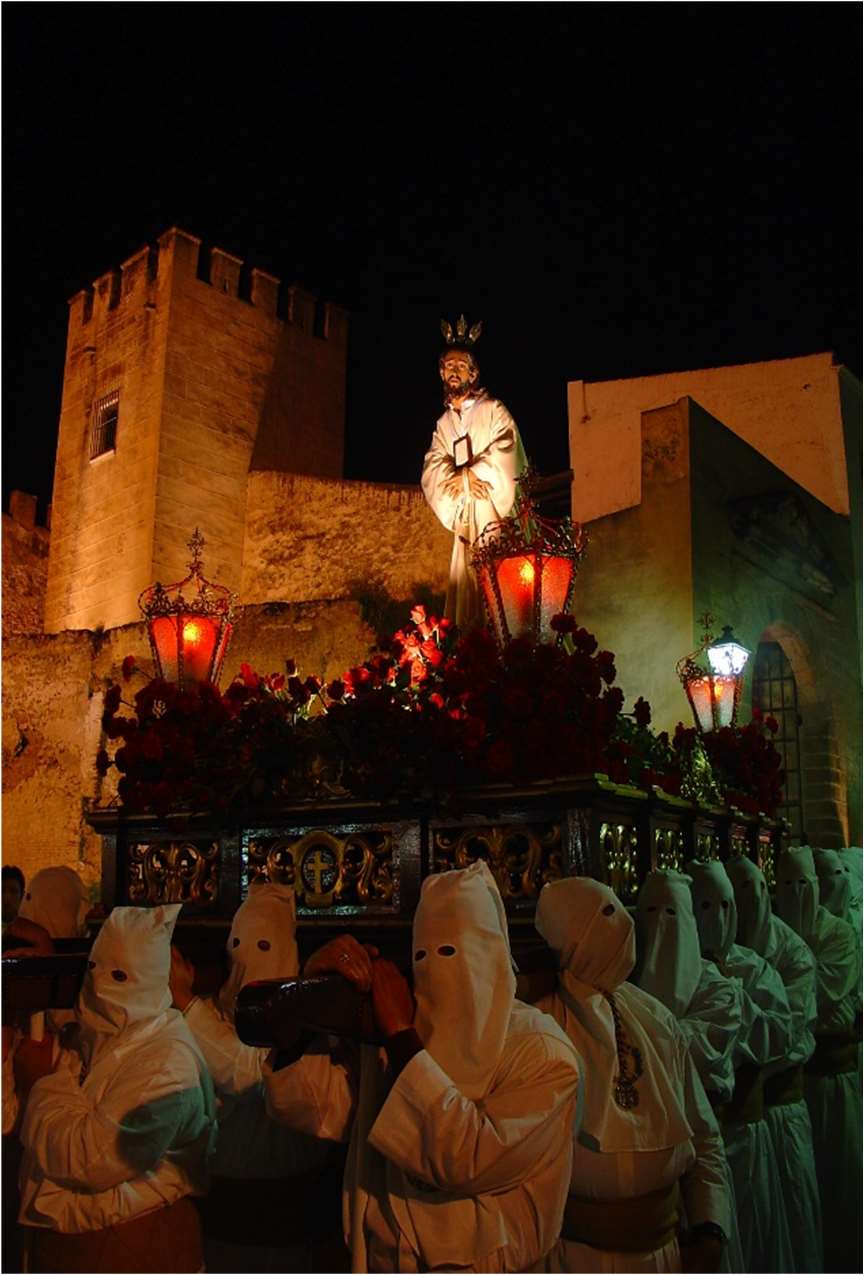
During its route, the parade makes strategic stops where events are carried out that enrich the Holy Thursday experience. In the emblematic Plaza Alta, which symbolizes the convergence of Arab and Christian cultures, the Fourteen Stations of the Via Crucis of S.S. John Paul II take place. This impressive act places the step in the center of the square, surrounded by 14 torches that burn under wooden crosses, symbolizing each station of the Via Crucis. This ritual refers to the first penitential processions that traveled through Spanish streets in the 13th century. The Nazarene brothers wear white tunics and hoods, and as a sign of penance, they can go barefoot or carry rough wooden crosses, carrying a lantern with a red candle inside.
This procession, eminently penitential and reflective, leaves a lasting impression due to the severity with which its penitents parade. In rigorous silence, it walks through the Historic District of Badajoz, accompanied by the overwhelming sound of the porters’ espadrilles and the bell that guides the step, in addition to the aroma of the incense burner that lingers in the streets.
The step belongs to the Brotherhood of Nuestro Padre Jesús de la Humildad, Nuestro Padre Jesús del Prendimiento, and María Santísima de los Dolores, an institution with more than 300 years of history. Like the venerated image that presides over the walk, a carving of incalculable artistic value created at the end of the 17th century. Despite the longevity of the brotherhood, this procession traveled through the streets of the city for the first time in 1988.
Undoubtedly, this parade stands out as one of the most special of the Holy Week in Badajoz, not only for the significant acts that take place and the hard work of the brothers but also for the places from which it can be enjoyed, with the Arab wall of the city being one of the most remarkable viewpoints.


